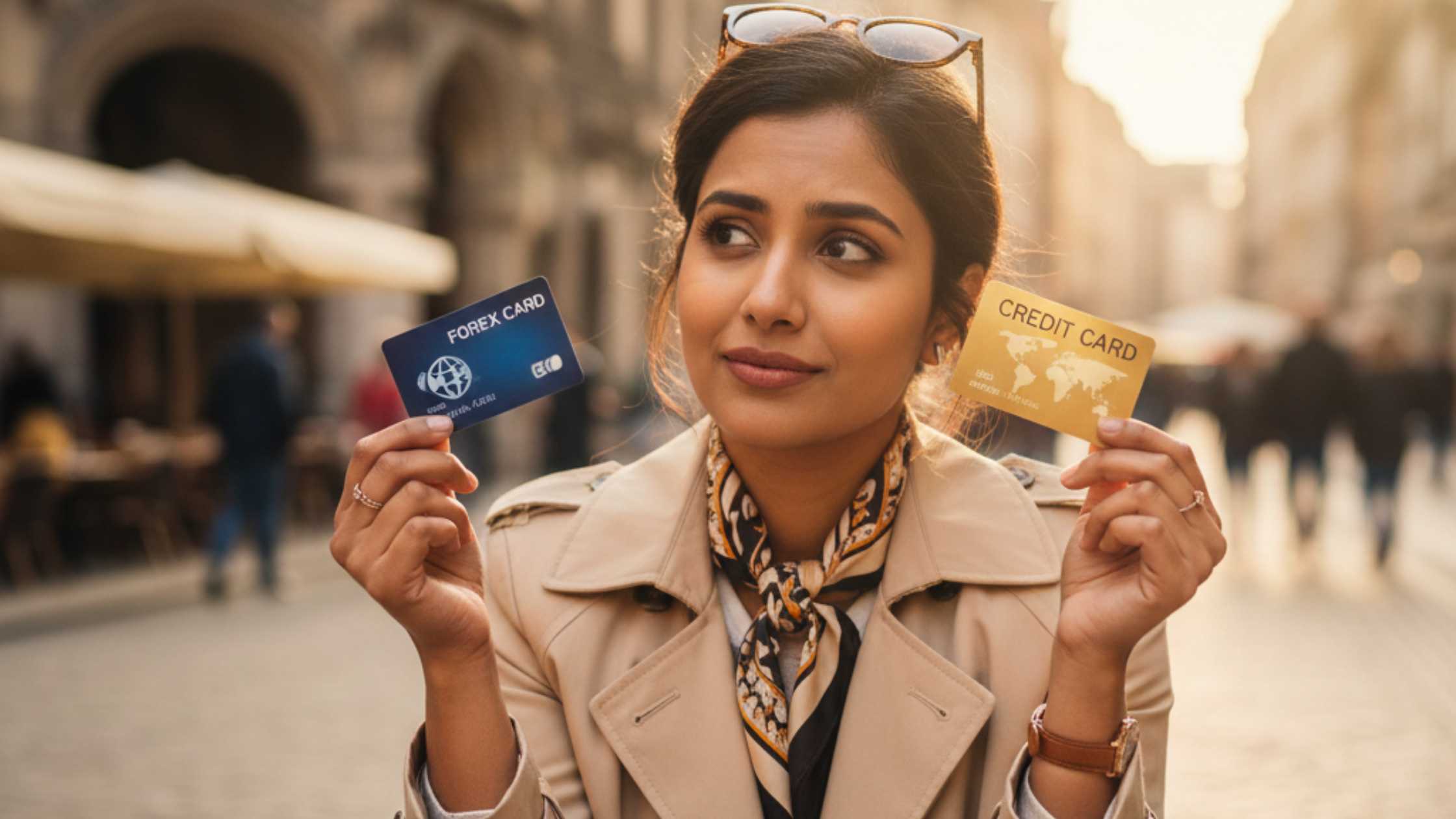
You’ve booked the tickets, stalked hotel reviews, and saved 100+ reels on “things to do in…”
And then, at the very end, the doubt hits you at the airport:
“Should I swipe my Indian credit card or use a forex card? What actually costs less? What’s safer?”
If you’ve ever stood at a POS machine abroad mentally calculating “forex markup + GST + maybe some mystery fee”, this guide is for you.
In this blog, you’ll discover forex card vs credit card in India:
- Which one actually saves you more money
- Where each one is safer and more convenient
- And toward the end, we’ll share a simple 3-layer “HerPocket Travel Money Stack” you can literally copy for your next trip.
Read till the end because just when you think “forex card is cheaper, done!”, there are a few situations where a credit card quietly wins big, especially if you choose the best credit card for international travel for your lifestyle.
What Is a Forex Card?
Think of a forex card as a travel wallet you fill before leaving India.
- You can load your card with USD, EUR, GBP, and other currencies at a fixed rate.
- You then swipe it outside India like a normal debit/credit card.
- The amount gets deducted in that foreign currency.
You can get forex cards from:
- Banks (HDFC, SBI, Axis, ICICI, etc.)
- Travel brands (e.g., Thomas Cook, MakeMyTrip partners)
Key point: When you load the card, you lock the exchange rate on that day. After that, even if the Rupee falls, your rate doesn’t change for the loaded currency.
What Happens When You Use an Indian Credit Card Abroad?
When you swipe your regular Indian credit card abroad:
- Your transaction happens in the local currency (say USD).
- Your bank converts that USD amount into INR.
- They add a forex markup fee (usually around 1.5%–3.5% + GST).
If you choose the right card (low forex markup, good rewards), the extra fees may be offset by:
- Air miles
- Reward points
- Cashback
- Travel benefits like lounge access, insurance, etc.
This is why people keep searching for the best credit card for international travel. It can seriously level up your travel experience.
How a Forex Card Works for Indian Women Travelling Abroad
Why Many Families and Students Prefer Forex Cards
Forex cards are especially popular if you’re:
- A student going abroad for higher studies.
- A parent sending money to your child overseas.
- A first-time traveller who doesn’t want to overspend.
- A family on a long vacation with a fixed budget.
Benefits of a forex card:
- Locked Exchange Rate
- You know exactly how many USD/EUR you have.
- Perfect if you’re the kind of person who tracks every rupee in a spreadsheet or Notes app.
- Budget Control
- You can decide: “This trip budget is $1,000. That’s it.”
- Keeps impulsive shopping under control.
- Safer Than Cash
- Lose cash = gone.
- Lose a forex card = you can block it and get a replacement (charger may apply).
- Multi-Currency Option
- Some cards let you hold multiple currencies at once.
- Useful if your trip covers more than one country.
Charges on Forex Cards You Should Actually Look At
Forex cards aren’t “free”. Before choosing one, always check:
- Card issuance fee – a one-time fee to get the card.
- Reload fee – if you add more money later.
- ATM withdrawal fee abroad – fixed amount per withdrawal.
- Inactivity fee – if the card lies unused for months.
- Cross-currency usage fee – using a USD card in a country where you’re paying in another currency (say THB).
A small pro tip:
If you know your rough daily budget, it’s cheaper to withdraw a slightly larger amount once than doing multiple small ATM withdrawals (due to fixed ATM fees).
How Credit Cards Work for International Travel from India
Why Credit Cards Are a Power Tool
Credit cards are like that friend who is amazing if respected, but dangerous if taken for granted.
Benefits of using a credit card abroad:
- High Acceptance
- Hotels, car rentals, and airline bookings often prefer credit cards.
- Sometimes they won’t even accept a debit or forex card for security deposits.
- Rewards and Miles
- You can earn travel points, flight miles, or cashback on your foreign currency spends.
- If you pick the best credit card for international travel for your pattern (airline-loyalty vs generic rewards), you can actually convert spends into free flights or hotel nights.
- Strong Protection
- If your card is misused, you can dispute transactions.
- Many banks offer zero liability after you report loss/theft.
- Chargeback options if a merchant scams you.
- Emergency Credit
- If your trip expenses exceed plan (hello, shopping), a credit card gives breathing room till your next billing date.
- Just don’t turn that into a habit.
Fees and Risks on Credit Cards You Need to Respect
Let’s be honest: credit cards abroad can become expensive if you ignore the fine print.
Watch out for:
- Forex Markup Fee
- This is the extra percentage the bank charges on every foreign transaction.
- Typical range: ~1.5%–3.5% of the transaction amount + GST.
- Lower forex markup = better for international use.
- Dynamic Currency Conversion (DCC)
- At the POS machine, sometimes you’ll see:
“Pay in:- Local Currency (USD/EUR/etc.)
- INR”
- Always choose local currency. Paying in INR lets the foreign bank decide the rate and fees. It’s usually worse than your Indian bank’s rate.
- At the POS machine, sometimes you’ll see:
- Cash Withdrawal on Credit Card
- Huge no-no unless it’s a real emergency.
- Interest starts immediately + cash advance fee.
- Not Paying Full Due Amount
- If you only pay the minimum due, you’ll keep paying high interest on the outstanding balance.
- Your “fun trip” turns into a long-term EMI.
Forex Card vs Credit Card in India – Side-by-Side Comparison
Let’s compare this like women compare skincare:
| Feature | Forex Card | Credit Card |
|---|---|---|
| Exchange Rate | Locked when you load | Daily rate + forex markup |
| Best For | Limited to the loaded amount | Hotels, flights, deposits, rewards & miles |
| Fees | Issuance, reload, ATM fee, inactivity | Forex markup %, interest, cash withdrawal fee |
| Rewards | Limited | Strong (miles, cashback, lounge access) |
| Safety | Safer than cash; can be blocked | Strong fraud protection & dispute support |
| Flexibility | A credit limit gives extra cushion | Credit limit gives extra cushion |
Reality check:
- A forex card can save on forex markup, but may have other small charges.
- A good international credit card might charge a forex markup but give back value in points, miles, and benefits.
This is why the game isn’t just “forex card vs credit card in India”…
It’s “forex card vs the right international credit card vs using both smartly”.
When a Forex Card Is Better for You
A forex card may be your primary travel buddy if:
- You’re a Student Going Abroad
- Parents can preload the card from India.
- Safe way to manage monthly expenses.
- You avoid taking on debt while still learning money habits.
- You’re on a Strict Budget
- Honeymoon, family trip, or solo trip with a clear budget.
- Once the loaded currency is done, you know you’ve hit your limit.
- You Don’t Want to Think About the Exchange Rate Daily
- You lock the rate once and stop obsessively checking USD/INR.
- You’re Travelling to a Place with Good Card Infrastructure
- Forex cards behave like normal debit/credit cards, which are widely accepted.
When a Credit Card Is Better for International Travel
A credit card may deserve the front pocket in your travel wallet if:
- You Travel Frequently (for Work or Leisure)
- Yes, you pay forex markup, but…
- You also earn miles, hotel points, or cashback.
- Over time, your spends can convert into almost-free tickets or hotel stays.
- You’re Booking Hotels, Flights & Car Rentals
- Many hotels block an amount as a security deposit.
- They’re more comfortable doing this on a credit card.
- Some car rentals or online bookings prefer or insist on credit cards.
- You Want Premium Perks
- Airport lounge access (before and sometimes during travel).
- Travel insurance, especially international medical coverage.
- Concierge services, flight offers, partner deals.
- You’re Confident With Bill Payments
- If you’re disciplined and always pay your bill in full, credit cards can be a powerful tool, not a trap.
This is where choosing the best credit card for international travel for your lifestyle matters more than blindly using any card you already have.
The Smartest Move: Use Both Together
Here’s where it gets interesting—and this is the strategy many savvy Indian women use without talking about it on Instagram captions.
The “Two-Card” Travel Strategy
Use:
- Forex Card → For your day-to-day spends
- Cafes, meals, local transport, shopping, experiences.
- Credit Card → For your big-ticket and security transactions
- Flights, hotels, deposits, online bookings, emergencies.
Why this works well:
- Your forex card keeps your daily budget under control.
- Your credit card gives protection + perks + flexibility.
- If one card fails/gets blocked, you’re not stranded.
We’ll soon get to the HerPocket 3-Layer Travel Money Stack that you can literally copy as a money packing list for your next trip.
How to Choose the Best Credit Card for International Travel
Instead of asking “Which is THE best credit card for international travel?”, ask:
“Which international credit card fits my income, travel frequency, and lifestyle?”
Here’s a decision framework.
1. Start with Forex Markup and Fees
Look for:
- Lower forex markup fees (closer to 1.5% is great, 3.5% is on the higher side).
- Reasonable annual fee (aim for a card where you can recover the fee via rewards or fee waiver conditions).
- Clearly stated cash withdrawal, late payment, and international ATM charges.
Even small differences in markup matter when your spends are high.
2. Look at the Rewards Structure
Ask yourself:
- Do I fly a lot and stick to one airline?
- Go for a co-branded airline card to rack up miles.
- Do I travel occasionally and prefer flexibility?
- A generic travel rewards or cashback card might be better.
Check:
- Reward earn rate on international spends.
- Any bonus offers for minimum international spends.
- How easy it is to redeem points (flights, hotels, vouchers, statement credit).
3. Check Travel Benefits Beyond Rewards
These are the “soft” perks that feel surprisingly good while travelling:
- Airport lounge access (domestic & international).
- Complimentary travel insurance or international medical cover.
- Forex offers on partner platforms (like MakeMyTrip, Cleartrip, etc.).
- Concierge support for bookings, restaurant reservations, etc.
If you travel 1–2 times a year, even occasional lounge access can make your long layovers more bearable.
4. Match the Card to Your Income and Usage
No need to chase the flashiest premium card just because Instagram says so.
- Pick a card you can realistically qualify for and fully utilise.
- Don’t pay a high annual fee for benefits you’ll never use.
- If you travel rarely, even a mid-segment card with decent markup and moderate rewards is enough.
The “best credit card for international travel” is the one that gives maximum value for your spend and lifestyle, not someone else’s.
Common Mistakes Indian Travellers Make with Cards Abroad
Let’s quickly clean up the big mistakes so you don’t repeat them.
1. Choosing “Pay in INR” at POS
Always pick local currency (USD/EUR/etc).
Paying in INR triggers Dynamic Currency Conversion and often higher, non-transparent rates.
2. Depending Only on One Card
Lost card, stolen wallet, or card blocked for “suspicious activity” = panic.
Always carry at least two different cards (and store them separately).
3. Using a Credit Card for Cash Withdrawals
Unless it’s a true emergency, avoid.
Interest + cash advance fee can be painfully high.
4. Not Informing the Bank About Your Travel
Sometimes banks block foreign transactions for security if they suddenly see foreign swipes.
Many banking apps now let you enable/disable international usage—turn it on before your trip.
5. Ignoring Expiry Date and Limits
- Check the credit card expiry before travel.
- Ensure your credit limit/forex card load is sufficient for the trip length and destination cost.
The HerPocket 3-Layer Travel Money Stack
Here’s the part I promised you earlier. If you’ve read till here, this will tie everything together.
Think of your travel money like layers of protection:
Layer 1: Everyday Spending – Forex Card
Use this for:
- Food, cafes, groceries, local transport, and shopping.
- Any predictable daily spend.
Why?
- Locked-in rates.
- You don’t overshoot your budget easily.
- Safer than carrying wads of cash.
Layer 2: Big-Ticket and Backup – Credit Card
Use your international-friendly credit card for:
- Flights, hotels, car rental, attraction tickets.
- Online bookings on foreign websites.
- Emergencies or last-minute expenses.
Why?
- Rewards and miles help recover some costs.
- Strong fraud protection.
- Extra buffer if trip costs go slightly above plan.
This is where having the best credit card for international travel makes a real difference—low forex markup + high travel rewards + relevant perks.
Layer 3: Small Cushion – Cash
Carry a bit of local currency cash for:
- Street vendors, small shops, tips.
- Places where cards don’t work.
- Backup if the network/card machines are down.
You don’t need to carry a huge amount. Just enough to cover 1–2 days of essential spends.
Put together, your HerPocket Travel Money Stack looks like this:
- Primary: Forex card (daily use)
- Secondary: Credit card (big spends + backup + rewards)
- Tertiary: Small amount of local cash
This way, you’re not over-dependent on any single mode, yet you’re not juggling 10 things.
Forex Card vs Credit Card in India: Verdict
Let’s wrap it up clearly.
- If you’re a student, first-time traveller, or on a fixed budget →
Make your forex card the hero and your credit card the sidekick. - If you’re a frequent flyer, business traveller, or someone who loves optimising points →
Focus on choosing the best credit card for international travel and pair it with a basic forex card for daily spends. - For most Indian women travellers today: The smartest move isn’t “forex card vs credit card in India”.
It’s a forex card + right credit card + little cash = safe, flexible, low-stress travel.